Trimming Yankee Sails by Faye Kert
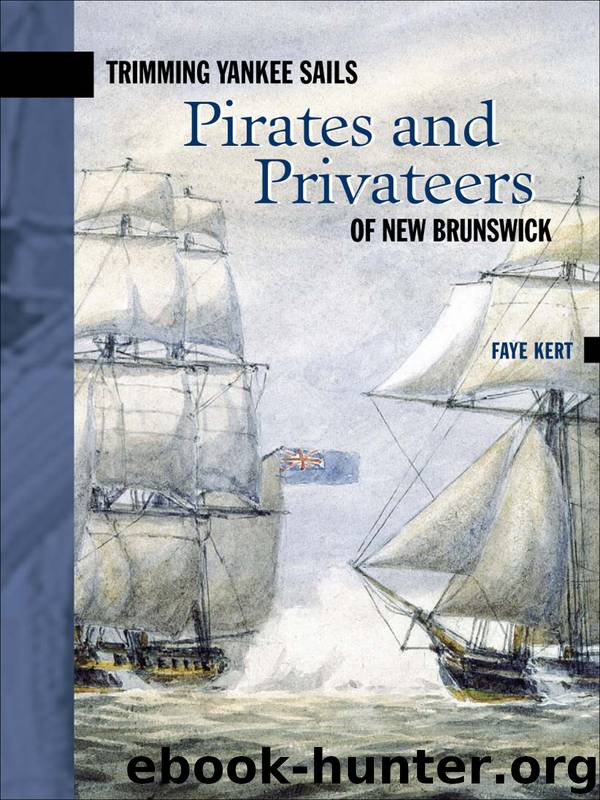
Author:Faye Kert
Language: eng
Format: epub
Tags: HIS027160
Publisher: Goose Lane Editions and the Gregg Centre for the Study of War and Society
Published: 2005-03-04T16:00:00+00:00
Capture of Snap Dragon, by Irwin John Bevan, June 30, 1814. Rechristened Snapdragon, the ship became New Brunswick’s last privateer. (MM)
Alternatives to Privateering
As trade dried up along the American coast, it brought with it rising prices for scarce commodities, food shortages, unemployment and serious hardship for many. Since there are no prizes on record for New Brunswick-owned vessels during 1814, it would appear that the British blockade and an increased naval presence in the Bay of Fundy effectively put an end to New Brunswick’s privateering activity, both real and arranged. Smuggling and illegal trade still persisted in and around the coast of Maine until British naval forces captured Eastport without a shot in July 1814. Interestingly, all the town’s inhabitants took an oath of allegiance to the King, including the deacon of the church, “a smooth-tongued man accounted one of the sleekest smugglers.” A month later, the nearby port of Castine fell, putting the territory from the Penobscot River to the Canadian border under British control and eliminating the need to smuggle.
Over the years, enterprising merchants on both sides of the border had managed to move goods over land and sea in spite of whatever restrictions were being enforced at the time. By the summer of 1814, with the entire coast of America under blockade, virtually the entire overseas trade of the United States was conducted with British licences through British ports, using British middlemen and lining the pockets of the British crown. The integration of American trade into the British system prompted Sir George Prevost, Governor-General of Canada, to complain that two-thirds of the British army in Canada were eating American beef. The fact that the British army and navy paid for their supplies with scarce cash ensured that such cross-border cooperation would continue — and that the United States fought the war with British gold.
Throughout the War of 1812, privateering, smuggling and counterfeit captures offered short-term solutions to the larger problem of restricted wartime trade while generating significant commercial activity. But capturing enemy vessels involved so many hazards with such an unreliable return on investment that the majority of New Brunswick’s maritime community preferred to make their living by ordinary means, if at all possible. While it may not have played a major role in the outcome of the war, privateering did provide an economic outlet for those sailors, ship owners and merchants who chose to participate in it. The newspaper reports of captures and recaptures raised the morale of people who had to put up with wartime shortages and deal with the occasional loss of friends and loved ones to battles or storms at sea.
By the time representatives of Great Britain and the United States signed the Treaty of Ghent on Christmas Eve 1814, however, both sides were heartily sick of fighting. Nearly three years of unwanted war were followed by a peace where nobody won. “Free Trade and Sailors Rights” had ceased to be an issue before war was even declared. Whatever else people fought for,
Download
This site does not store any files on its server. We only index and link to content provided by other sites. Please contact the content providers to delete copyright contents if any and email us, we'll remove relevant links or contents immediately.
| Africa | Americas |
| Arctic & Antarctica | Asia |
| Australia & Oceania | Europe |
| Middle East | Russia |
| United States | World |
| Ancient Civilizations | Military |
| Historical Study & Educational Resources |
Cat's cradle by Kurt Vonnegut(15351)
Pimp by Iceberg Slim(14506)
4 3 2 1: A Novel by Paul Auster(12391)
Underground: A Human History of the Worlds Beneath Our Feet by Will Hunt(12097)
The Radium Girls by Kate Moore(12028)
Wiseguy by Nicholas Pileggi(5783)
The Fire Next Time by James Baldwin(5442)
Perfect Rhythm by Jae(5403)
American History Stories, Volume III (Yesterday's Classics) by Pratt Mara L(5307)
Paper Towns by Green John(5189)
Pale Blue Dot by Carl Sagan(5007)
A Higher Loyalty: Truth, Lies, and Leadership by James Comey(4960)
The Mayflower and the Pilgrims' New World by Nathaniel Philbrick(4502)
The Doomsday Machine by Daniel Ellsberg(4490)
Killers of the Flower Moon: The Osage Murders and the Birth of the FBI by David Grann(4447)
The Sympathizer by Viet Thanh Nguyen(4390)
Too Much and Not the Mood by Durga Chew-Bose(4348)
The Borden Murders by Sarah Miller(4325)
Sticky Fingers by Joe Hagan(4198)
